Word Code - Cryptogram Puzzle
- 4.8
- Rating
- 10.00K
- Installs
- Free
- Price
 Analysis by App-foxy
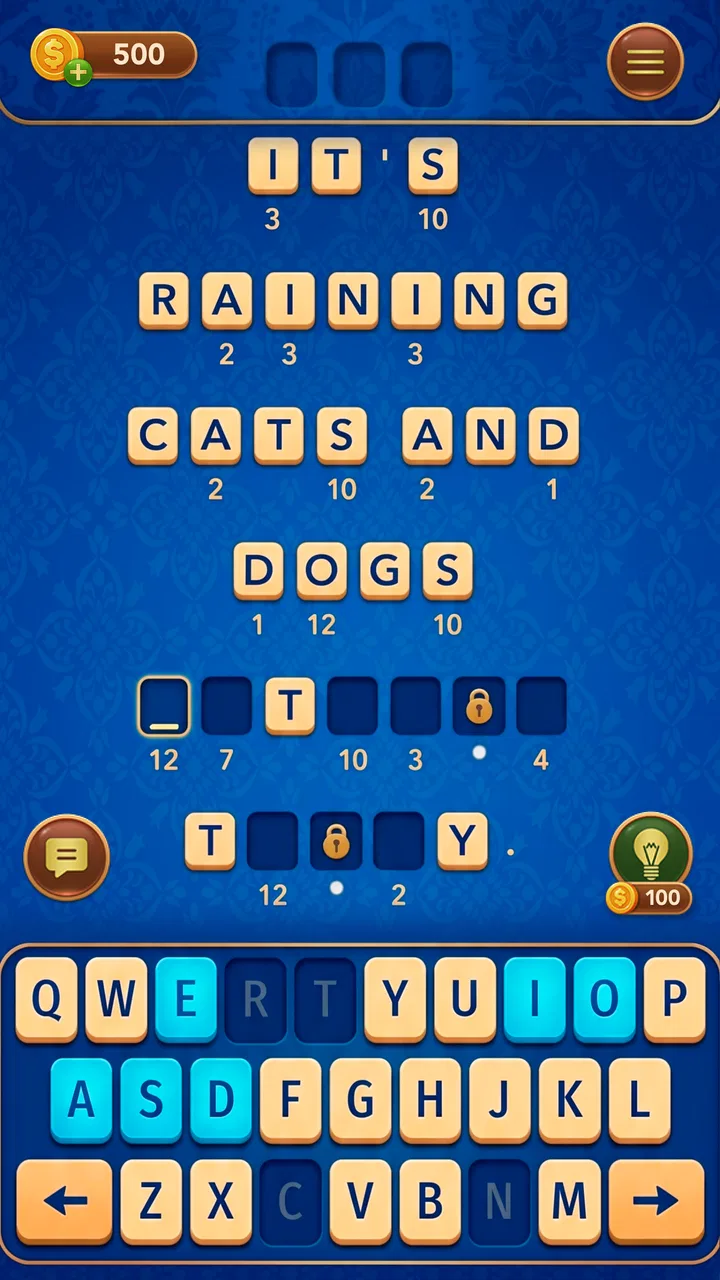
I picked up Word Code - Cryptogram Puzzle expecting a quick word game, but I found something that works best as a small shared challenge rather than a mindless way to fill time. It combines word guessing, logic puzzles, and cryptograms, so the experience shifts between vocabulary, pattern recognition, and careful deduction. I like that mix because it gives me a reason to slow down instead of tapping through the same type of puzzle repeatedly.
It is a free word game from SayGames Ltd, rated for Everyone and available for devices running Android 8.0 or later. The current version is 1.2.3, and its average rating sits at 4.9 from around 557 ratings, with more than 10K installs. Those figures suggest that it has attracted a modest but very positive early audience, although I would still treat it as a newer title rather than a long-established puzzle classic.
How Word Code fits into a shared household
The most enjoyable way I used it was in short turns with another person nearby. One player could look at a cryptogram and suggest a possible word, while the other checked whether the letter pattern actually made sense. That creates a useful distinction between guessing and proving an answer. A quick suggestion may get the conversation moving, but the puzzle still rewards the person who notices a repeated letter, a familiar word shape, or a clue that rules out an attractive mistake.
You May Also Like

 AccuWeather: Weather Radar
AccuWeather Review: A Quick, Clear Forecast for Everyday Decisions
For everyday plans, the best forecast is the one you can understand quickly. AccuWeather makes rain timing, radar, and local conditions easy to act on, with a few trade-offs.

 Hill Climb Racing
Why Hill Climb Racing Still Turns Crashes Into One More Run
A tiny car, a bumpy hill and one more upgrade: Hill Climb Racing keeps resurfacing because its simple chaos makes every near-miss feel personal.

 AliExpress - Shopping App
AliExpress Makes Global Shopping Feel Personal, but Shoppers Bear the Risk
AliExpress turns a global marketplace into a pocket-sized discovery engine. Its reach is useful, its shopping loop compelling, and its trade-offs easy to miss.

 Lords Mobile: Kingdom Wars
Lords Mobile Is a Kingdom-Building Routine, Not a Quick Match
A case-by-case verdict on the building, battles, device demands, and social commitments that make Lords Mobile rewarding for some players and exhausting for others.

 PDF Scanner app - TapScanner
TapScanner Makes Paperwork Easier to Capture, Check, and Share
TapScanner makes scanning with a phone feel less like a rescue operation and more like a dependable step in getting work done. Its capture tools are useful, though not flawless.

 Block Blast!
 Shows How Much a Puzzle Game Can Leave Out
A quiet grid game shows why puzzle players increasingly value instant clarity, repeatable skill and low-pressure play—and where the genre still needs to catch up.
More From Our News Desk
View All News


This makes the game suitable for a shared phone or tablet in situations where people are already together: waiting for food, sitting in a living room, or taking a short break. It does not need to become a formal family activity. A single puzzle can be treated as a small conversation, with one person holding the device and everyone else thinking aloud. I found that particularly useful when someone wanted to play but did not want to sit alone with a competitive game.
There is also a practical benefit to taking turns. Cryptogram puzzles can become frustrating when one player stares at the same pattern for too long. Passing the device or simply inviting another person to inspect the clue often exposes a letter relationship that was easy to miss. In that sense, the game naturally supports cooperation without needing a separate team mode or any invented household feature.
Still, it is important to understand what shared use does not solve. The game is designed around the person interacting with the screen, so a group has to create its own turn-taking routine. If one player enjoys solving everything immediately, others may become spectators. I would set a simple rule before starting: allow everyone to propose a solution, and only enter an answer after the group has discussed it. That keeps the activity from turning into one person’s private puzzle session.
What the first sessions feel like
The word puzzles are approachable because they invite ordinary language knowledge, while the logic side asks me to pay attention to relationships rather than just vocabulary. Cryptograms sit between those two styles. I may recognize a likely word, but the answer only feels reliable when the surrounding pattern supports it. That extra step is what gives the game more staying power than a basic word scramble.
I also noticed that the game suits uneven skill levels better than many traditional word games. A strong reader can suggest possible answers, while someone less confident can focus on matching letters or spotting repeated structures. Nobody has to know every word in advance to contribute. The trade-off is that a player who wants a purely relaxed experience may find the deduction element more demanding than expected.
For a household, I would avoid presenting it as a test of intelligence. A wrong answer usually says more about an overlooked pattern than about a person’s ability. Framing each puzzle as a shared investigation makes the experience friendlier, especially when children and adults are using the same device. The Everyone content rating makes it broadly suitable from an age-label perspective, but an adult should still decide whether the vocabulary and challenge level fit a particular child.
Setting boundaries before passing around the device
Because the game is free to download, it is easy to let someone start playing without much preparation. I would still check the device’s purchase settings before handing it to a child or a guest. The game includes in-app purchases ranging from $1.99 to $99.99 per item, so “free” describes the starting cost, not a guarantee that every optional transaction is harmless to a shared budget.
This is one of the clearest household boundaries to establish. If the device is used by several people, agree that nobody buys anything without asking the account holder. That conversation matters more than the puzzle itself, because a child may reasonably interpret an on-screen offer as part of normal play. I would also avoid leaving a payment-enabled device unattended with a young player, even during a short break.
There is another boundary worth setting: decide whether solving is allowed to continue when the device owner is not present. In a family setting, someone might open the game, make progress, and leave the next person with a partially changed puzzle state. If the household cares about keeping a shared challenge intact, use a simple verbal rule such as “finish the current puzzle or leave it untouched.” This is not a built-in feature; it is a practical habit that prevents small disagreements.
For a personal device, I found the best setup to be a short session with notifications and other distractions kept out of reach. The game’s appeal depends on noticing details, and interruptions make the cryptogram layer feel more irritating than it really is. On a shared device, that same focus is harder to maintain, so I would choose a time when nobody needs the phone for messaging, navigation, or another urgent task.
Coordinating turns without making it feel like homework
A useful method is to give each player a different job. One person can read the clue or inspect the visible pattern, another can suggest likely words, and a third can challenge the suggestion by looking for contradictions. This keeps quieter players involved and prevents the fastest guesser from controlling the whole session. It also highlights the game’s central strength: the answer becomes more satisfying when the group can explain why it fits.
I would not keep a complicated score. The game already supplies the puzzle objective, and adding a leaderboard can make a casual household session unnecessarily tense. Instead, remember which kinds of clues caused trouble. If repeated letters were confusing, pause and explain the pattern. If vocabulary was the obstacle, let the player describe the meaning they expect before anyone enters a guess. That approach turns a difficult round into a small learning moment without pretending the app is a formal educational tool.
Another practical tip is to stop after a natural breakpoint rather than forcing one more puzzle. Cryptograms demand concentration, and the quality of discussion drops when everyone is tired. With a shared device, ending at the right moment also makes it easier for the next person to play without feeling that they are interrupting someone’s long session. I prefer several brief rounds to one extended attempt that ends in frustration.
Coordination matters even for two adults. One player may want to solve independently, while the other enjoys talking through every possibility. Before starting, decide whether hints, guesses, or outside help are acceptable. If the goal is conversation, discussing the pattern is part of the fun. If the goal is personal improvement, giving away an answer too quickly weakens the challenge. The game supports both styles, but the players need to agree on the style themselves.
Age, trust, and the limits of a general audience label
The Everyone rating makes Word Code an easy title to consider for a family device, but an age label should not replace supervision or judgment. A child may be perfectly comfortable with word guessing yet struggle with the more abstract logic behind a cryptogram. Another child may solve the pattern quickly but become upset by repeated mistakes. I would introduce it as an optional puzzle, not as an activity that must be completed correctly.
Trust is also relevant when several people use one device. The game may be passed between family members, but that does not mean every player wants their progress altered. I would ask before opening another person’s session and avoid assuming that a shared tablet means shared ownership of every puzzle. A small amount of respect prevents the common household complaint that someone “ruined” a game by solving or changing it.
For older players, the game offers a calm alternative to faster mobile entertainment. It can be a good choice for someone who enjoys crosswords, deduction games, or word searches but wants a more compact format. However, a person who prefers large, themed crossword grids may find the experience too segmented. Likewise, anyone looking for a social multiplayer game with direct competition should choose a different category entirely; this is better suited to taking turns and discussing answers than to head-to-head action.
Compared with a paper cryptogram book, the app is more convenient because the device is already available and the puzzle can be approached in short bursts. Paper has the advantage of being easier to annotate freely and of avoiding purchase prompts or screen-time concerns. Compared with a basic anagram game, this title asks for more reasoning and less rapid rearrangement. Compared with a daily word game, it appears broader in spirit because it combines several puzzle approaches rather than relying on one familiar routine.
That comparison also shows where it may not be the right choice. If you want a completely offline-feeling paper activity, a printed book is simpler. If you want a predictable daily ritual, a focused daily word game may be more satisfying. If you want a game that can entertain a large group without any house rules, this one requires more coordination. Its strength is the middle ground: compact digital puzzles with enough logic to discuss, but not so much complexity that a casual player is excluded immediately.
What I would tell someone before downloading
I would recommend it to a reader who likes language puzzles but gets bored when every round follows the same formula. The combination of word guessing and cryptogram reasoning gives each session a slightly different mental texture. It is especially appealing if you enjoy explaining how you reached an answer, because the reasoning can be as satisfying as the answer itself.
I would also mention the free entry point clearly. You can begin without paying, but the presence of in-app purchases means I would review the device’s purchase protections first, particularly for children or a shared family account. The developer is SayGames Ltd, and the app’s current version is 1.2.3, so keeping the installation updated is sensible when the platform offers an update.
The positive rating of 4.9 is encouraging, yet the audience is still relatively small at around 557 ratings and over 10K installs. I read that as a promising early response rather than proof that it will suit everyone. A newer puzzle game can feel fresh, but its long-term value depends on whether its available challenges continue to hold your attention. For that reason, I would try it as a low-commitment download rather than expecting it to replace every other word game on the device.
My biggest practical criticism is not about the core idea; it is about the friction that appears when a person wants a completely uninterrupted, no-cost puzzle experience. Free games often need some form of optional monetization, and here the purchase range means households should be deliberate. The game is also less satisfying when played while distracted, because the difference between a clever deduction and a random guess becomes blurred.
There is a quieter limitation too: the game’s best social quality depends on the people around you. Alone, it remains a useful short puzzle session. With another thoughtful player, it becomes more memorable because you compare interpretations and test each other’s reasoning. With a noisy group or someone who gives away every answer, the same puzzles lose much of their value. That makes the surrounding routine almost as important as the app.
My household verdict
After using it as both a solo game and a shared-device activity, I see Word Code - Cryptogram Puzzle as a strong choice for calm, cooperative puzzle time. It is free to start, suitable for an Everyone-rated audience, and flexible enough for a quick individual round or a conversation between family members. The most rewarding sessions were not the ones where I solved everything quickly, but the ones where another player noticed a pattern I had overlooked.
I would download it for a household that enjoys wordplay, wants something quieter than an action game, and is willing to set simple rules around turns and purchases. I would skip it for anyone seeking a fully competitive multiplayer experience, a large crossword-style workspace, or a game that requires no attention at all. Its appeal comes from concentration, deduction, and discussion.
My final advice is to treat it as a shared puzzle box rather than an endless distraction. Keep purchase boundaries clear, let players choose whether they want hints, and stop before the group becomes tired. Used that way, the game earns its place on a family device: not because it solves every need, but because it gives people a compact reason to look at the same screen and think together.
FAQs for Word Code - Cryptogram Puzzle
01What is Word Code - Cryptogram Puzzle about?
Word Code - Cryptogram Puzzle is a challenging word game that involves deciphering cryptograms. Players are presented with encoded messages that they must decode using logic and word knowledge. The game tests your puzzle-solving skills and vocabulary, providing a fun and educational experience for puzzle enthusiasts.
02How does the gameplay work in Word Code - Cryptogram Puzzle?
In Word Code - Cryptogram Puzzle, players are given encrypted phrases where each letter is substituted with another letter. The objective is to decipher the message by swapping the letters back to their original state. Hints and clues are available to assist players, making it suitable for both beginners and advanced puzzle solvers.
03Is Word Code - Cryptogram Puzzle suitable for all ages?
Yes, Word Code - Cryptogram Puzzle is designed to be family-friendly and suitable for all ages. While the puzzles can be challenging, the game offers various difficulty levels and hints to accommodate younger players or those new to cryptograms. It's a great way to enhance vocabulary and critical thinking skills in a fun way.
04Does Word Code - Cryptogram Puzzle require an internet connection?
No, Word Code - Cryptogram Puzzle can be played offline, making it an excellent choice for on-the-go gaming without the need for a constant internet connection. This feature allows players to enjoy the game anywhere, whether traveling or simply taking a break without worrying about data usage.
05Are there any in-app purchases in Word Code - Cryptogram Puzzle?
Yes, Word Code - Cryptogram Puzzle offers in-app purchases. Players can buy additional hint packs and unlock premium content for a more enriched gaming experience. However, the core game is free to play, and purchases are optional, allowing players to enjoy the game without spending money.
Pros
- Engaging puzzles keep your mind sharp.
- Intuitive interface simplifies gameplay.
- Variety of levels for all skill levels.
- Offline mode available for travel play.
- Regular updates with new challenges.
Cons
- Ads can interrupt gameplay frequently.
- Limited hints may hinder progress.
- Requires in-app purchases for extras.
- Some puzzles may feel repetitive.
- No multiplayer or social features.

Word Code - Cryptogram Puzzle
Gallery